
Spiral Plate Heat Exchangers: Engineering, Selection, and Market Trends
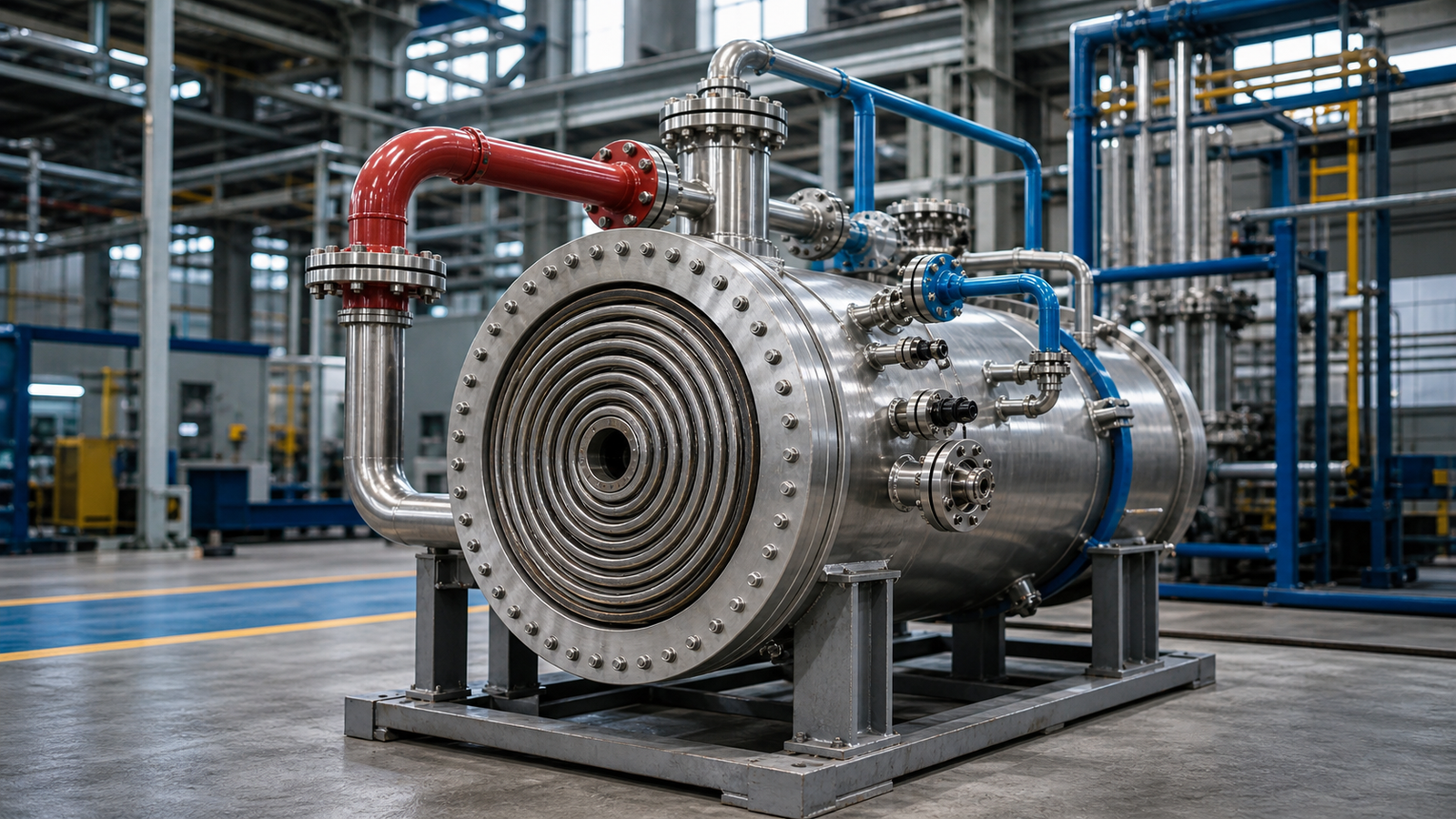
Spiral plate heat exchangers look deceptively simple. Two long metal sheets are wound around a center, creating two separate spiral channels. One fluid enters from the center and moves outward, while the other follows the opposite path. The result is a compact counterflow heat exchanger with a flow pattern that is difficult for conventional tubular equipment to reproduce.
That geometry explains why the technology has remained relevant for nearly a century. It is especially useful when the fluid is dirty, viscous, particle-laden, or prone to fouling. Yet the same geometry also makes manufacturing quality critical: a spiral plate heat exchanger is only as good as its forming, spacing, welding, sealing, and inspection discipline.
From Invention to Industrial Platform
The modern spiral plate heat exchanger concept is commonly traced to the early twentieth century and the Rosenblad design tradition in Sweden. Its early value proposition was direct: replace bulky equipment with a compact exchanger that could provide strong counterflow heat transfer and tolerate difficult process media better than many tube bundles.
The later industrialization of the technology turned the spiral plate from a clever geometry into a repeatable pressure-vessel product. Over time, the equipment evolved from fixed, harder-to-clean units toward more maintainable designs, improved materials, automated forming, and more controlled welding methods.
Why Spiral Flow Performs Differently
In a spiral plate exchanger, each side generally follows one continuous channel. This is different from equipment with many parallel tubes or narrow plate passages, where maldistribution and dead zones can appear if the fluid contains solids or has unstable viscosity.
The curved channel produces secondary flow and wall shear. For clean liquids, that improves heat transfer. For fouling-prone streams, it can also help keep particles suspended and reduce the tendency for deposits to build up in quiet regions. This is the reason spiral plate units are often considered for refinery bottoms, slurry cooling, crystallizing liquids, wastewater concentration, pulp and paper streams, and high-viscosity process fluids.
Manufacturing Quality Is the Real Differentiator
The most important buying question is not whether a supplier can roll two plates into a spiral. It is whether the supplier can repeat the geometry, welds, and sealing quality consistently.
Key manufacturing factors include:
- Channel spacing: small variation can create uneven velocity, local fouling, or pressure drop surprises.
- Stud or spacer welding: spacer height, weld penetration, and distribution affect both strength and flow behavior.
- Edge forming: smooth, consistent edges reduce dead zones and support reliable sealing.
- Main weld quality: continuous, low-defect welds are essential for pressure integrity and cross-contamination control.
- Heat input control: excessive heat can distort thin plate, damage corrosion resistance, or create residual stress.
Advanced suppliers use automated forming, controlled welding, inspection programs, and operating data to reduce these risks. Lower-cost suppliers may still produce usable equipment, but buyers should examine the application severity before treating all spiral plate exchangers as equivalent.
Spiral Plate Versus Shell-and-Tube
The comparison is not about declaring one technology universally better. Shell-and-tube exchangers remain strong choices for very high pressure, very clean service, simple maintenance expectations, or cost-sensitive duties. Spiral plate exchangers are more compelling when the process problem is fouling, footprint, heat recovery, or difficult liquids.
Typical spiral plate advantages include compact layout, high thermal effectiveness, a long counterflow path, and better tolerance of certain dirty or viscous streams. Typical limitations include more demanding fabrication, project-specific design work, and pressure ranges that may not match heavy tubular equipment in extreme services.
For many plants, the lifecycle economics are decisive. A spiral plate unit may cost more at purchase, but if it extends cleaning intervals, reduces unplanned shutdowns, and preserves heat recovery performance, the total operating cost can be lower.
Where Spiral Plate Heat Exchangers Fit Best
Strong candidate services include:
- Refinery and petrochemical streams with heavy hydrocarbons or suspended solids.
- Pulp, paper, and fiber-containing process liquids.
- Wastewater and evaporation duties with scaling tendency.
- Mineral processing slurry and hydrometallurgical liquids.
- Compact heat recovery projects where space is limited.
- Valuable or hazardous media where welded construction is preferred.
Less suitable cases include ultra-high-pressure duties, very clean utility fluids where a simpler exchanger is cheaper, or processes where extremely low pressure drop is more important than heat transfer intensity.
Competitive Landscape and China Market Direction
International brands have accumulated decades of design data, manufacturing routines, and service knowledge. Their strength is not only equipment geometry; it is the combination of repeatable production, materials experience, inspection culture, and lifecycle support.
Chinese manufacturers have moved from early imitation and standardization toward broader domestic production and selected high-end applications. The market now shows a familiar split: premium projects tend to value proven references and quality systems, while lower-risk duties often prioritize price and delivery speed.
For Chinese suppliers, the next stage is likely to depend on specialization rather than broad imitation. Stronger positions can come from mastering a narrow set of duties, building real test data, improving welding automation, documenting lifecycle performance, and offering service beyond the initial equipment sale.
Quote Request Checklist for Buyers
When requesting a spiral plate exchanger quotation, include more than flow rate and inlet/outlet temperatures. A useful quote request should also describe fouling mechanism, solids content, particle size, viscosity curve, corrosive species, cleaning method, allowable pressure drop, operating cycle target, inspection requirements, and material preferences.
Ask suppliers to explain channel gap selection, weld inspection, mechanical cleaning access, pressure vessel code compliance, and comparable references. These answers will reveal more than a low initial price.
Takeaway
Spiral plate heat exchangers are not general-purpose replacements for every heat exchanger. They are specialized tools for duties where compact counterflow heat transfer, dirty-fluid tolerance, and long operating cycles matter.
The best projects treat spiral plate technology as an engineered system: flow behavior, welding, forming, cleaning, material selection, and service support must be evaluated together. When those pieces align, the spiral plate exchanger can solve problems that conventional equipment only manages through oversizing, frequent cleaning, or lost heat recovery.